Wooden shape sorter puzzle
This classic toy helps toddlers develop fine motor skills and shape recognition through engaging play.
Games & Puzzles
6 kinds worth knowing, 9 picks, and what to check before you buy.
Wooden puzzles tend to go to two very different people: a toddler who is just learning how shapes fit into holes, and an older kid or grandparent who likes a quiet challenge at the kitchen table. For little ones, the puzzles that get used have a few big pieces, easy grips and pictures they already know, like farm animals or the alphabet. For older solvers, a 3D interlocking puzzle or a tilting maze gives them something to work at over several evenings. Before you pick, think about the person's age and patience more than the theme. A wooden puzzle also lasts, so it can be passed to a younger sibling or kept on a shelf for years.
Kind 1 of 6
A shape sorter is a board or box with cut-outs where circles, squares and triangles drop into place. It suits babies moving into the toddler stage who are working out how things fit. Pick one with only a few shapes to start, since too many cut-outs can frustrate a small child. Check the age range on the packaging, make sure the pieces are big enough to hold with a whole hand, and look for smooth edges and a finish meant for young children.
This classic toy helps toddlers develop fine motor skills and shape recognition through engaging play.
Ideal for babies and toddlers, this puzzle promotes sequencing, size differentiation, and fine motor skills.
Kind 2 of 6
These are wooden pieces that slot together into a cube, ball or knot, and they often come apart only in one exact order. They work well for older kids, teens and adults who like brain teasers, and they make a good desk ornament for a grandparent. Flat tangram sets fit here too, for anyone who likes arranging shapes into patterns. Before you buy, check the difficulty level, whether the solution is included, and how many pieces there are. Very hard puzzles can end up in a drawer.
A captivating brain teaser for teens and adults, requiring spatial reasoning to assemble complex structures.
A challenging brain teaser that encourages spatial reasoning and creativity for older children and adults.
Kind 3 of 6
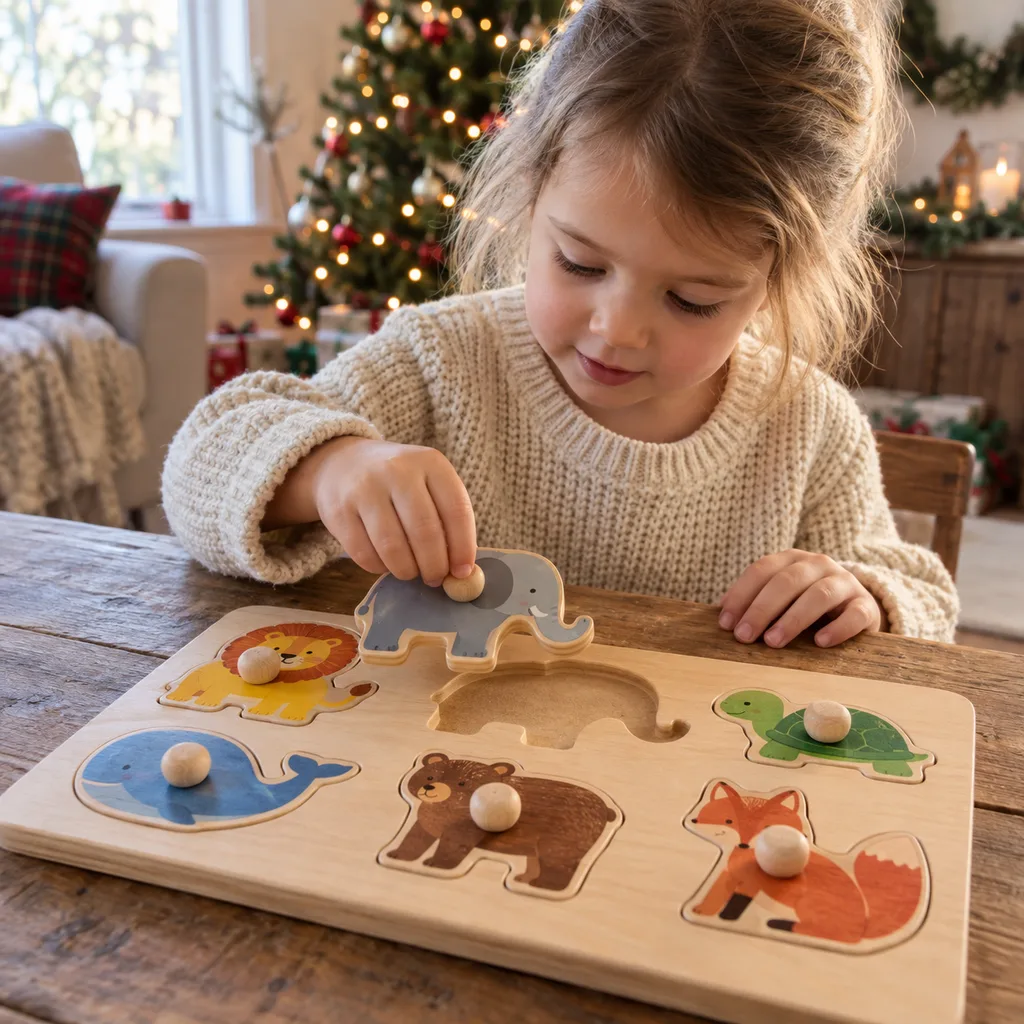
Chunky animal puzzles have thick pieces shaped like cows, ducks or lions that sit in a matching tray or stand up on their own. Toddlers like them because they can name the animals and play with the pieces as little toys once the puzzle is done. Check that the pieces are thick enough to pick up without fumbling, that the tray shows a picture under each piece, and that the age range suits the child. Animals the child already knows usually get the most use.
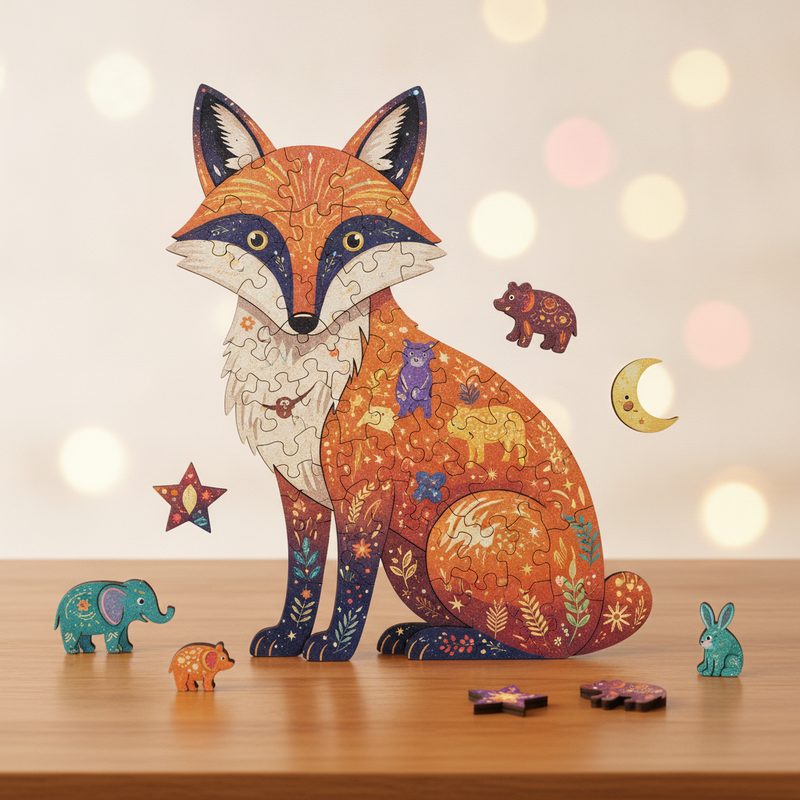
A jigsaw cut into tiny foxes and moons that assembles into wall-worthy art
Perfect for little hands, this puzzle helps young children identify animals and develop grasping skills.
Kind 4 of 6
A large-piece wooden jigsaw is a step up from peg boards. The pieces interlock like a regular jigsaw but are bigger and sturdier than cardboard. They suit preschoolers who have outgrown single-shape puzzles, and older adults who find small pieces hard to handle. Check the piece count against the person's patience, see whether it comes with a frame or tray to keep the edges together, and choose a picture with clear colours so matching pieces is satisfying rather than tedious.
A delightful activity for families or individuals, encouraging problem-solving and shared moments.
Kind 5 of 6
An alphabet peg puzzle is a board with a letter-shaped piece for each letter, and each piece has a small knob for lifting it out. It suits toddlers and preschoolers who are starting to notice letters in books and on signs. Check whether it has upper or lower case, since kids often learn capitals first. Make sure the pegs are firmly attached, and look for a picture printed under each letter to help with matching. A board with 26 pieces can take a while to finish.
This educational puzzle assists preschoolers in learning letters and developing hand-eye coordination.
Kind 6 of 6
A wooden labyrinth has a marble and a maze board that you tilt with knobs or by hand to guide the ball past holes to the finish. It suits school-age kids and adults who like a hands-on challenge, and it is easy to pick up for a few minutes at a time. Check how hard the maze is, whether the marble is held inside the frame, and whether the board is sized for a lap or a tabletop.
This engaging puzzle challenges dexterity and focus, guiding a ball through intricate pathways.
Looking for one person in particular? Shop by person.
Everything else
Showing 1–9 of 9