The verdict
Best for planned essentials and portable high-power jobs
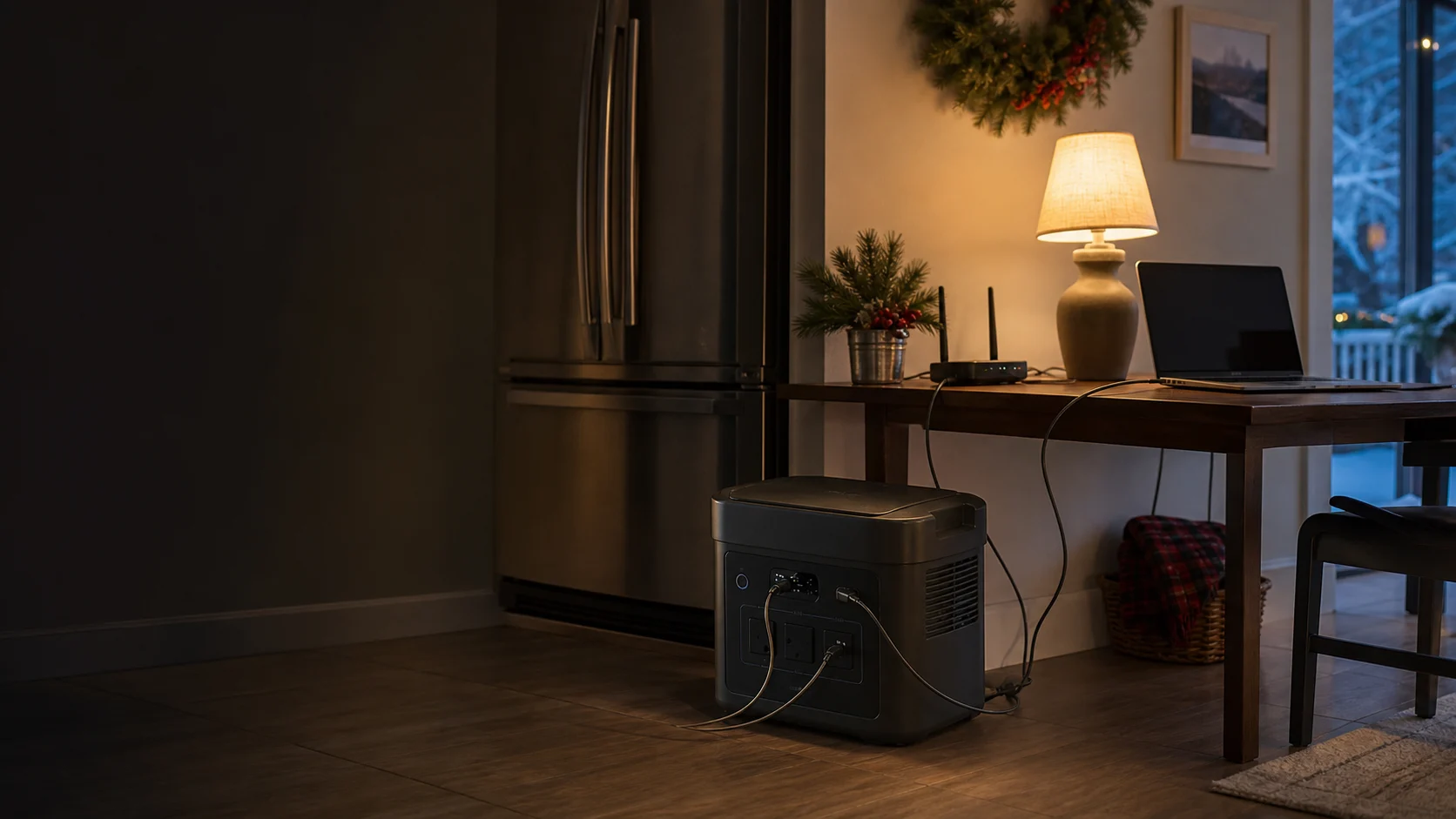
Choose North American model EF-DL-H10-4 for someone who will calculate loads, prioritize appliances and recharge between outages or trips. Its 1,800 W continuous output handles many household devices, but runtime shrinks quickly with heat-producing appliances. It is not whole-home backup and must never be backfed into household wiring.
Why it works
- ✓ 1,024 Wh LFP capacity balances useful backup time with 27.6-pound portability
- ✓ Up to 1,500 W AC input can refill it in roughly an hour
- ✓ Two 500 W solar inputs accept up to 1,000 W combined with a compatible setup
Tradeoffs
- × Usable AC energy is lower than the 1,024 Wh nameplate after conversion losses
- × Fans cycle more and the unit runs hotter during sustained high-power operation
- × Solar panels, specialty charging cables and home integration are generally separate
Do the load and runtime math before ordering
- Load: add each device's running watts and check startup surge against 1,800 W continuous and 3,600 W surge limits.
- Runtime: estimate usable watt-hours ÷ average load watts; nameplate capacity is not fully available through AC outlets.
- X-Boost: its claimed 2,600 W support changes voltage behaviour and is not universal sustained output.
- Transfer: less than 10 ms is fast, but this is not a zero-transfer online UPS or a medical/safety-critical guarantee.
- Placement: keep it dry, leave vents clear and never connect an AC output to home wiring without approved equipment and an electrician.
What should arrive—and what usually costs extra
| Decision | Expected package | Plan separately |
|---|---|---|
| Core setup | DELTA 3 Plus, AC charging cable and documentation | Solar panels and compatible solar cabling |
| Expansion | Built-in AC, USB and 12 V outputs | Extra batteries, alternator charging and approved home-transfer equipment |
DELTA 3 Plus, RIVER 2 Pro or a larger DELTA?
| Decision | Choose DELTA 3 Plus | Choose the alternative |
|---|---|---|
| Portable choice | 1,024 Wh and 1,800 W fit the intended loads | RIVER 2 Pro when lower weight matters more than capacity and output |
| Backup scale | Selected appliances for hours, with disciplined load switching | A larger DELTA system for longer runtime or multiple large simultaneous loads |
Quick answers
How much AC energy is actually usable?
Less than 1,024 Wh because the inverter and system consume energy. Solar Lab measured about 82% efficiency under a demanding 1,573 W load; efficiency varies with load and conditions.
How quickly does it recharge from a wall outlet?
EcoFlow claims about 56 minutes under its specified fast-charge conditions; independent testing recorded roughly 55 minutes.
What can its USB and DC ports supply?
It has two 36 W USB-A ports, two 140 W USB-C ports, and car plus DC5521 outputs sharing 126 W. Check each device and port limit.
Does it require the EcoFlow app?
No for basic local operation. Wi-Fi and Bluetooth app control are optional for settings, monitoring and updates.
Can it charge below freezing?
No. EcoFlow specifies charging from 0–45°C and discharging from -10–45°C. Bring a cold unit into its safe charging range first.
Sources
- EcoFlow Canada: DELTA 3 series portable power station — Official output, charging, solar, transfer and battery-life claims; checked August 5, 2026.
- EcoFlow Canada Store: DELTA 3 Plus portable power station — Canadian specifications, dimensions, weight, package and five-year warranty claim.
- EcoFlow Manuals: DELTA 3 Plus user manual — Official port, temperature, operation and safety instructions.
- The Solar Lab: EcoFlow DELTA 3 Plus review — Independent efficiency, refill, solar, temperature and fan observations.
Exact-model Amazon.ca search for EF-DL-H10-4. As an Amazon Associate, XmasGoat earns from qualifying purchases. Verify the model, seller, included cables, warranty and electrical fit before ordering.